

Impact
A Future with Sustainable Growth Integrated with Environmental and Cultural Projects
A Future with Sustainable Growth Integrating
Environmental and Cultural Projects
GROWTH WITH GLOBAL SUSTAINABILITY
UNIVERSAL VALUES
PRESERVATION OF NATURAL HERITAGE
FOR FUTURE GENERATIONS
Email us at our Contacts.
Email: contatos@illea.org.br
To contact us:
Call/WhatsApp: +55 51 99333-1336
Latin American Institute of Environmental Studies - ILLEA
Latin American Institute of Environmental Studies – ILLEA
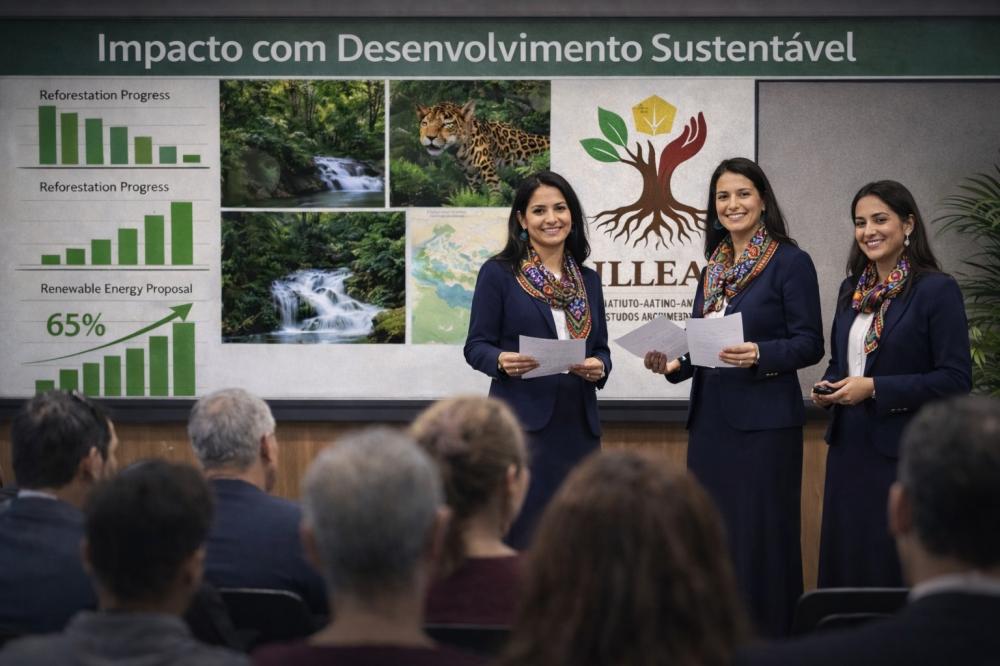
We declare that our impact will be very positive and has been highly anticipated in recent years with actions for the preservation of the Environment in Biodiversity, Health, Education and Culture, promoting ethics, citizenship and human rights for the full and effective democracy of all universal values, articulating with the Public and Private sectors and Civil Society proposals for actions of public and collective interest in accordance with the purposes of this Institute.
The Ministry of the Environment and Climate Change (MMA) supports environmental projects focused on biodiversity, biome restoration, combating deforestation and environmental restoration, and projects on climate change. Furthermore, the Ministry supports projects related to climate change, including adaptation and mitigation strategies. This involves reducing greenhouse gas emissions, promoting renewable energy, and developing policies that make cities and communities more resilient to extreme weather events.
ENSURING QUALITY OF LIFE
In this way, the Ministry of the Environment and Climate Change (MMA) acts as a facilitator between government, civil society, the productive sector, and the scientific community, promoting integrated actions aimed at guaranteeing sustainable development, protecting Brazils natural heritage, and ensuring quality of life for present and future generations.
The Institute will contribute to strengthening the local, regional, national, and global economy through the generation of sustainable opportunities, community capacity building, environmental education, and the encouragement of productive practices with high environmental impact. Actions that promote social inclusion, improved quality of life, food security, preventive health, and the strengthening of community leadership, reducing inequalities and stimulating economic models aligned with sustainability.
Working in the conservation and enhancement of biodiversity through environmental studies, preservation projects, ecosystem recovery, and the promotion of the sustainable use of natural resources. By encouraging responsible practices and nature-based solutions, it contributes to the protection of species, the maintenance of ecosystem services and environmental balance, ensuring the resilience of territories and the preservation of natural heritage for future generations.
CULTURAL IMPACT
Our cultural impact manifests itself in the appreciation of traditional knowledge, popular wisdom, and cultural expressions associated with the relationship of communities with nature. The OSCIP promotes the integration between culture, environment, and education, supporting cultural actions, publications, workshops, events, and training projects that strengthen local identity, collective memory, and the culture of sustainability.
The environmental OSCIPs work generates continuous positive impacts on ecosystem conservation, the production of scientific knowledge, the strengthening of public policies, and the culture of promoting sustainable practices, contributing to environmental balance, addressing climate change, and the well-being of society.
Playing a fundamental role in the appreciation, preservation, and dissemination of culture, by integrating environmental knowledge with traditional knowledge, cultural expressions, and sustainable community practices.
Through research, publications, educational projects, and cultural activities, the Institute contributes to the recovery and appreciation of ancestral knowledge, such as the traditional use of medicinal plants, agroecological practices, and ways of life in harmony with nature, strengthening the cultural identity of communities. The OSCIPs work promotes environmental education as a cultural expression, encouraging sustainable habits, values, and behaviors that are reflected in art, literature, oral tradition, pedagogical practices, and local cultural manifestations.
Through the production and circulation of cultural content—books, teaching materials, exhibitions, workshops, discussion groups, and events—the OSCIP broadens societys access to environmental knowledge, democratizing culture and promoting ecological awareness. The cultural impact is also manifested in civic education, by encouraging community leadership, respect for cultural diversity, and the construction of a culture of peace, cooperation, and socio-environmental responsibility.
Thus, the Latin American Institute of Environmental Studies (ILLEA) aims to consolidate a modern and sustainable culture, in which the environment, education, health, and cultural heritage are integrated, strengthening public policies and leaving a positive legacy for present and future generations.
OUR IMPACT ON PROMOTING DEVELOPMENT
Fostering development with sustainability and a culture of encouragement of sustainable productive practices. Supporting the green and solidarity economy. Generating local opportunities. Promoting economic growth coupled with conservation. Institutional action also drives the protection of biodiversity, the recovery of ecosystems, and the adoption of nature-based solutions, ensuring the maintenance of ecosystem services and the environmental resilience of territories.
Environmental Justice and Sustainable Development through knowledge production, environmental education, socio-environmental innovation, and articulation with public policies, promoting integrated positive impact in the environmental, social, cultural, and economic spheres.
Strengthening communities and territories by encouraging sustainable practices, local capacity building, opportunity generation, appreciation of traditional knowledge, and stimulation of the green economy, expanding social impact and community autonomy.
With ethical, transparent management aligned with ESG principles and the Sustainable Development Goals (SDGs), the Environmental Studies OSCIP promotes lasting impact, strengthening the culture of sustainability and contributing to a fairer, more balanced, and sustainable development.
The union between Culture and the Environment and the Global Environment brings the strengthening of Environmental Education and Awareness. Appreciation of Traditional Knowledge, Community Engagement and Belonging, Identity and Resistance to Climate Change, Comprehensive Support for Sustainability (Socio-environmental). Sustainable Cultural Events such as the Sustainable Turnaround.
Alignment with the Sustainable Development Goals strengthens the Environmental and Governance pillar. Partnerships with companies and public, private, and international organizations. Habitat and Species Preservation - Protected areas safeguard remaining forests and other significant biomes, ensuring the survival of fauna and flora and preventing species extinction.
OUR IMPACT ON ECOSYSTEM MAINTENANCE
Protected and rehabilitated areas are crucial for climate regulation, water purification, protection against natural disasters, and maintenance of nutrient cycles vital to life on Earth. Climate Resilience - Climate regulation is one of the greatest contemporary environmental challenges and requires integrated actions based on science, education, and social participation. The Environmental Studies NGO acts strategically to contribute to mitigating climate change and strengthening the resilience of ecosystems and communities. Territorial conservation, particularly for communities, proves effective in mitigating climate change, as intact vegetation acts as a carbon sink.
Working towards Carbon Neutrality, or carbon neutrality, is the balance between greenhouse gas (GHG) emissions and their removal from the atmosphere, resulting in a net zero balance. Achieved through emission reduction and offsetting (carbon credits, reforestation), the concept aims to combat climate change. Reduction and Offsetting: Focusing on reducing emissions where possible and offsetting the remainder, usually through environmental projects.
FOREST RESTORATION
Restoring degraded forests aims to restore biodiversity, soil, and ecosystem services through techniques such as active planting, managing natural regeneration, agroforestry systems (SAFs), and the use of ecological techniques (perches, soil translocation). Essential actions in permanent preservation areas (APP) and legal reserves reduce flooding and capture carbon, being crucial for food security and income generation.
Promoting sustainable practices and nature-based solutions, strengthening essential ecosystem services such as climate regulation, water quality, soil fertility, pollination, and food security.
The actions developed also contribute to mitigating the impacts of climate change, increasing the environmental resilience of territories and reducing processes of degradation, deforestation, and biodiversity loss.
Climate regulation contributes to the maintenance of ecosystems, water security, public health, and sustainable development, reaffirming the commitment to the future of the planet and future generations.
By integrating science, environmental education, and community participation, the Environmental Studies OSCIP strengthens a culture of care for ecosystems, ensuring their long-term maintenance and leaving a positive legacy for present and future generations.
Policies for the preservation, conservation, and sustainable use of ecosystems, biodiversity, and forests; proposing strategies, mechanisms, and economic and social instruments for improving environmental quality and the sustainable use of natural resources; Policies for the integration of environment and production, ecological-economic zoning.
Support for Research and Education serves as a concept for Sustainable Development, focusing on Knowing, Learning, Doing, Living Together, and Being, aiming for a holistic understanding, practical action, social interaction, and integral development for sustainability, integrating environmental, social, cultural, and economic aspects.